
-
Mock exercise held in major hospitals of ICR to strengthen…
-
State’s first renal transplant carried out at TRIHMS
-
SIFF voices concerns over SUMP, questions deployment of security personnel
-
Family of deceased school student protest outside Yupia…
-
Tawang Marathon: Khandu launches new logo, official T-shirt
-
APU must aim for greater heights, says new VC Prof.…
-
CM calls high level meeting following ANSU’s 48-hr bandh…
-
Governor visits Armed Forces outreach and awareness enclosures
-
Centre extends AFSPA in three Arunachal districts, few…
-
138 Bn CRPF clinches Inter- Battalion football title in…
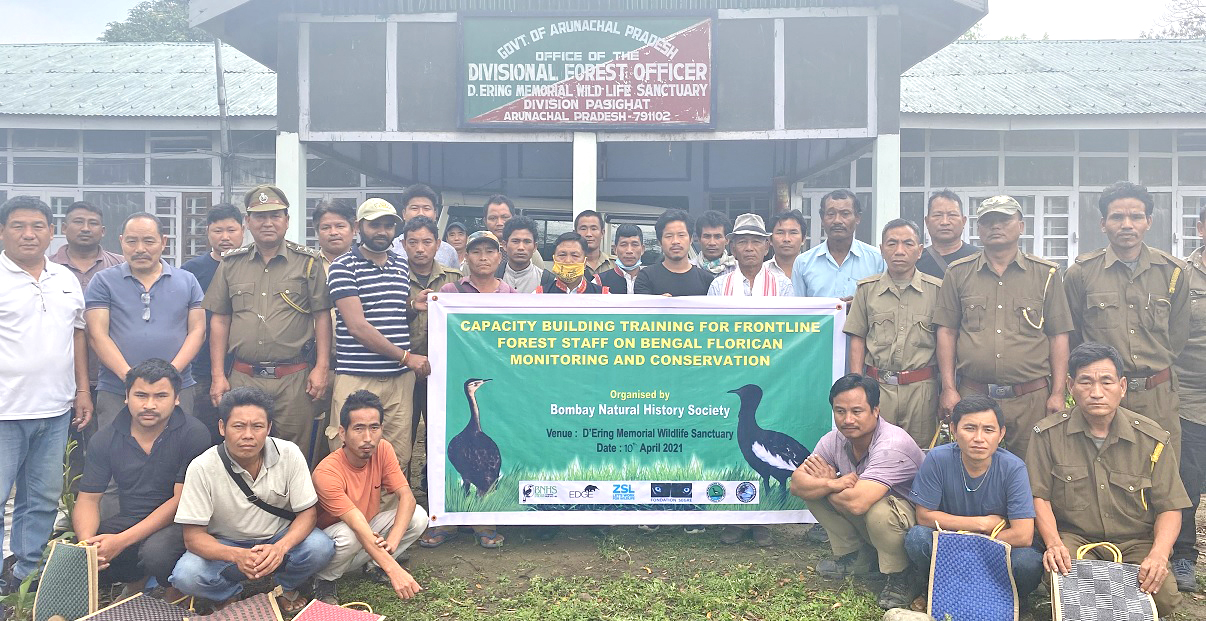
PASIGHAT, Apr 12: The Bombay Natural History Society (BNHS) based in Mumbai, Maharastra with support from ZSL EDGE, Segre Foundation and D. Ering Wildlife Sanctuary Division organized a daylong capacity building training on rare and critically endangered ‘Bengal Florican’ monitoring and conservation, for frontline staff of D. Ering Wildlife Sanctuary at the Division office here at Pasighat on April 10.
The programme focused on monitoring and conservation of critically endangered Bengal Florican in the Sanctuary. The programme was attended by Tasang Taga, DFO, D. Ering Wildlife Sanctuary Division, Naning Perme, RFO, Borguli Range, Orin Perme, RFO, Anchalghat Range, Domek Koyu, RFO, Sibiyamukh Range, Maksam Tayeng, Wildlife enthusiast cum Member, State Board for Wildlife, Scientists Dr. Biswajit Chakdar and Ngulkholal Khongsai including field staff of BNHS and 25 frontline staff of the Sanctuary.
BNHS scientist and EDGE Fellow Dr. Biswajit Chakdar gave an audio-visual presentation on identification of Bengal Florican and protocol to monitor the bird. He also gave accounts of the species and associated threats to the species in Northeast India.
Earlier, Tasang Taga and Maksam Tayeng in their speech highlighted about the importance of the training programme and they also thanked the team of BNHS for organizing the training programme which will be very helpful in monitoring and proper care of the Bengal Florican, locally called ‘Sitong Periik’ in the sanctuary’s grassland.
D. Ering WLS has the highest population of Bengal Florican at a place in India. The short grasses of the sanctuary, which cover about 80 percent of the total area is most suitable for this grassland obligate birds like critically endangered Bengal Florican, informed scientists from BNHS. DIPRO

Kenter Joya Riba
(Managing Editor)She is a graduate in Science with post graduation in Sociology from University of Pune. She has been in the media industry for nearly a decade. Before turning to print business, she has been associated with radio and television.
Email: kenterjoyaz@easternsentinel.in / editoreasternsentinel@gmail.com
Phone: 0360-2212313