
-
Mock exercise held in major hospitals of ICR to strengthen…
-
State’s first renal transplant carried out at TRIHMS
-
SIFF voices concerns over SUMP, questions deployment of security personnel
-
Family of deceased school student protest outside Yupia…
-
Tawang Marathon: Khandu launches new logo, official T-shirt
-
APU must aim for greater heights, says new VC Prof.…
-
CM calls high level meeting following ANSU’s 48-hr bandh…
-
Governor visits Armed Forces outreach and awareness enclosures
-
Centre extends AFSPA in three Arunachal districts, few…
-
138 Bn CRPF clinches Inter- Battalion football title in…
ES Newsdesk
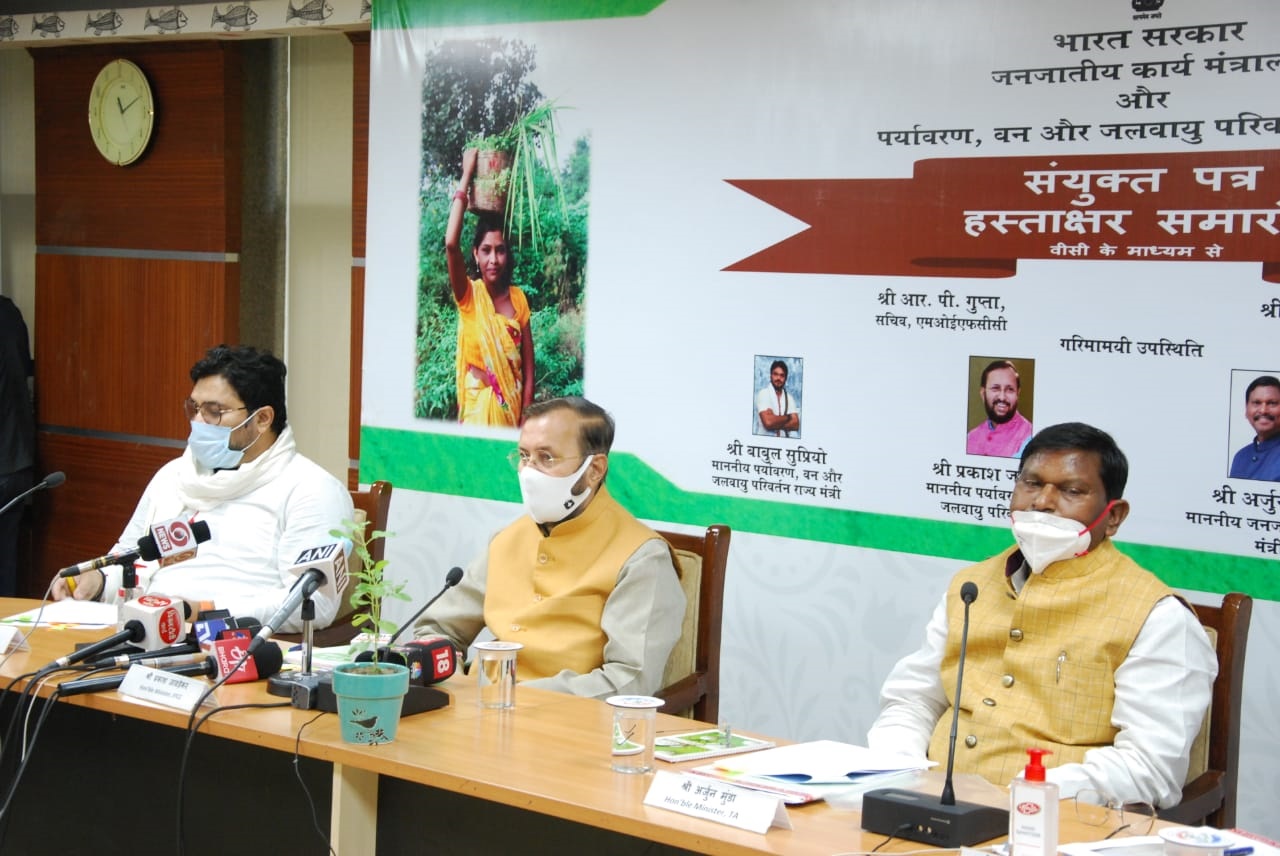
NEW DELHI, Jul 6: In a landmark initiative aimed at giving more powers to all the tribal communities in the country including Arunachal Pradesh in managing forest resources, the Union Ministries of Environment, Forest & Climate Change and Tribal Affairs today signed a Joint Communication in presence of Prakash Javadekar and Arjun Munda, the respective ministers, here in the national capital.
Signed by the Chief Secretaries of the two ministries, the chief objective of the Joint Communication (JC) is to extend more rights to the Gram Sabha and tribal communities in managing their forest resources as enumerated in the Scheduled Tribes and Other Traditional Forest Dwellers (Recognition of Forest Rights) Act, 2006, commonly known as the Forest Rights Act (FRA).
It can be recalled that the Union Tribal Affairs Minister in a tweet a few months back hinted that in the coming two years, the Central government would start granting community rights in relation to management of forest resources and the Ministries of Tribal Affairs and Environment, Forests & Climate Change will act jointly in that direction.
Terming the signing of the JC a historic day, Javadekar said that the Union government is committed for the welfare of tribal communities and forest dwellers. It will empower tribal communities and help in effective implementation of the Forest Rights Act, he said, informing that five lakh tribals have been given land rights and more than 25 thousand committees of Gram Sabhas have been formed in the last seven years. The tribal budget has also been doubled and four lakh forest dwellers have benefitted from the Van Dhan Scheme, Javadekar added, while directing the Forest and Tribal Officers to include the Gram Sabhas in the planning and management process of forests under the new initiative.
Munda said that the country’s tribal communities and forest dwellers have always promoted the conservation of forests and signing of the JC will expand the applicability of the Forest Rights Act which in turn will help in maintaining biodiversity and sustenance of forest resources.
The Ministry of Tribal Affairs is the nodal agency for implementation of FRA provisions and although it has issued appropriate guidelines and directions to the Chief Secretaries of all states in this regard, lack of coordination between the departments of Tribal Affairs and Forests in certain states resulted in deprivation of tribal societies/groups over their rights to manage forest resources.
It has often been observed that despite implementation of the FRA, due to diverse rules and regulations of Forest departments and also due to misinterpretations by the forest bureaucracy, many states haven’t granted the rights of reconstruction, protection, conservation and management of their forests. This has been a reason why the implementation level was not even 10% since 2007.
Welcoming the change, the Akhil Bharatiya Vanavasi Kalyan Ashram (ABVKA) has said that although late, it’s a right step, hoping along with that the anomalies arising while implementing the agreed provisions, if any, would be timely corrected for a letter and spirit implementation of the JC both at the Central and state level.
Now that the process of extending community rights is expected to gather momentum following the milestone initiative, the ABVKA has urged the tribal community groups, especially their political representatives, social activists and educated youths to help the tribal people in understanding the new changes in relation to community forest rights and help them in having a clear idea of the revised procedural norms.

Kenter Joya Riba
(Managing Editor)She is a graduate in Science with post graduation in Sociology from University of Pune. She has been in the media industry for nearly a decade. Before turning to print business, she has been associated with radio and television.
Email: kenterjoyaz@easternsentinel.in / editoreasternsentinel@gmail.com
Phone: 0360-2212313