
-
Mock exercise held in major hospitals of ICR to strengthen…
-
State’s first renal transplant carried out at TRIHMS
-
SIFF voices concerns over SUMP, questions deployment of security personnel
-
Family of deceased school student protest outside Yupia…
-
Tawang Marathon: Khandu launches new logo, official T-shirt
-
APU must aim for greater heights, says new VC Prof.…
-
CM calls high level meeting following ANSU’s 48-hr bandh…
-
Governor visits Armed Forces outreach and awareness enclosures
-
Centre extends AFSPA in three Arunachal districts, few…
-
138 Bn CRPF clinches Inter- Battalion football title in…
Talo Moyong
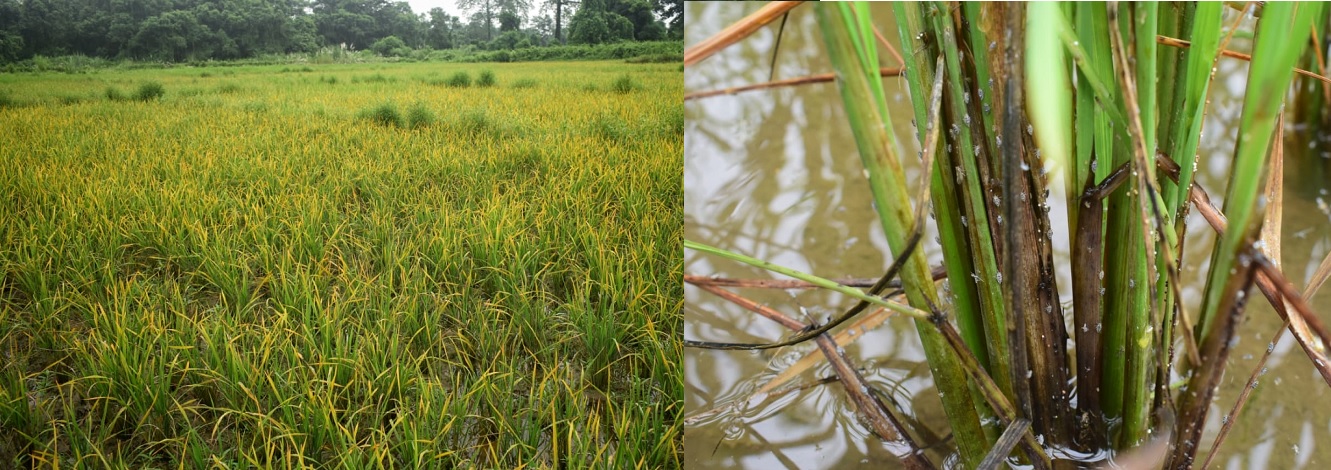
Adding more woes to the damage caused to the “rice bowl of East Siang” due to flood, an outbreak of White Backed Plant Hopper (WBPH) is causing extensive damage to the paddy fields of various villages under Pasighat Sadar, Mebo, Geku, Yagrung and Ruksin Circles, with Mebo and Yagrung being severely affected.
WBPH is one of the most widespread pests out of all the 21 paddy pests. Both the nymphs (immature stage) and adults of the pest suck plant sap from the leaf sheath region (above water surface but below leaf blade) and tend to congregate near it. Leaves of the damaged plants turn yellow, starting from tip and then later to rust-red colour. In severe cases, the damaged plants usually dry up and die which results in a brownish hue appearance called “Hopper Burn”. Even if the plant survives, it will not be able to produce ears or panicles, if control measures are not taken in time.
In order to control the pest, preventive measures from the nursery stage itself is a must. Since WBPH first appears in low population during June-July, the control is much easier then. For this, the seeds should be treated or mixed with Thiamethoxam 25 WG @ 4g/kg of seed before sowing or may be treated with imidacloprid 17.8 WS@ 5-8g/kg of seed. During transplanting, a spacing of 20x15 cm between plants and rows should be maintained. By August-September the pest population becomes quite high, so it is better to monitor the fields from time to time. Spraying of Imidacloprid 17.8 SL @1ml/L of water should be done as soon as the pest first appears i.e 10 insects/hill. Application may be repeated if the hopper population persists beyond a week after previous application. In case the field is heavily infested, the water draining method along with spraying of Imidacloprid must be done. The field should be drained and kept dry for 2-3 days in a week and this method should be repeated for at least 3-4 times during the peak infestation period. This will result in reduction of more than 50% of pest population.
The other methods include spraying of fungi Beauveria bassiana @ 5gm/litre of water and also Neem based insecticide @1ml/litre of water. Removal and burning of dead and highly infested plants is necessary and grassy weeds should be checked, since the insect tends to overwinter on them. After all control measures, if the plants are sprayed with micronutrient solution, it will help in revival at a faster rate.
Though these control measures are proven to be effective, their implementation has come rather late due to which large areas of paddy fields have already been damaged which has cost a huge loss to the farmers of the region. This will definitely cause a reduction in rice yield, which may lead to an increase in price of food grains. Generally, WBPH infestation is easy to manage if detected early and with proper implementation of the above mentioned control measures.
Lastly, I would like to appeal to the state government to pay some attention to the problems faced by the farmers and take necessary action to prevent losses and protect the state’s agriculture.
The author is Master in Agriculture and Entomology and an alumni of CHF, Pasighat

Kenter Joya Riba
(Managing Editor)She is a graduate in Science with post graduation in Sociology from University of Pune. She has been in the media industry for nearly a decade. Before turning to print business, she has been associated with radio and television.
Email: kenterjoyaz@easternsentinel.in / editoreasternsentinel@gmail.com
Phone: 0360-2212313