
-
Mock exercise held in major hospitals of ICR to strengthen…
-
State’s first renal transplant carried out at TRIHMS
-
SIFF voices concerns over SUMP, questions deployment of security personnel
-
Family of deceased school student protest outside Yupia…
-
Tawang Marathon: Khandu launches new logo, official T-shirt
-
APU must aim for greater heights, says new VC Prof.…
-
CM calls high level meeting following ANSU’s 48-hr bandh…
-
Governor visits Armed Forces outreach and awareness enclosures
-
Centre extends AFSPA in three Arunachal districts, few…
-
138 Bn CRPF clinches Inter- Battalion football title in…
Maksam Tayeng
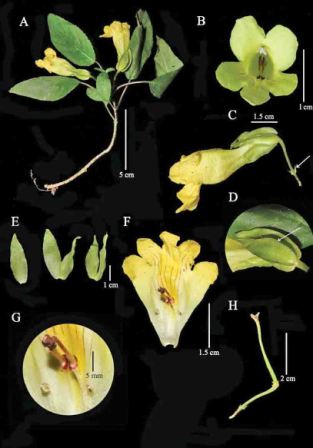
PASIGHAT, Sep 9: Researchers from Rajiv Gandhi University and Goalpara College, Assam along with a citizen-scientist from Geku in Upper Siang have discovered a new species of Henckelia (Gesneriaceae) plant from Pasighat.
The plant which was found in April last year at an elevation of 375 meter from sea level grows in inaccessible locations of rocky crevices and cliffs where there is abundance of moisture and shade. The plant belongs to the genus Henckelia under the family Gesneriaceae comprising about 70 species. The members of Henckelia are distributed throughout India, Bangladesh, Nepal, Bhutan, China, Myanmar, Sri Lanka, Thailand, Laos and Vietnam. As per researchers, in India the genus has so far been represented by 35 species, out of which 19 are found in the Himalayas and Northeast.
The plant was named ‘Henckelia Siangensis’ to honour the Siang Valley from where it was discovered. The local name of the new species in Adi language is 'Libe-Lirak Appun' meaning “the plant that grows on rocky cliffs and crevices.” So far, the new species is known only from its type-locality in East Siang district which can be treated as endemic to the state. The population size of Henckelia Siangensis is very small which is less than 100 and is found only in a single location and its search in other locations has been futile so far.
The credit for discovery of the new species goes to Momang Taram, the researcher who has been working on the family 'Gesneriaceae' for the last two years and has discovered many species from the region, although the fate of many of them is critical due to chances of near extinction. “They were described with very small population sizes and need immediate attention. A community level approach like designation of some community forests as protected areas in the form of biodiversity parks, gardens etc. can help in preserving many such unique plants before they get lost forever,” Taram suggested.
Researchers like Taram are of the view that Arunachal Pradesh is blessed with rich and diversified flora and fauna, but due to developmental activities a good portion of them are on the verge of extinction.

Kenter Joya Riba
(Managing Editor)She is a graduate in Science with post graduation in Sociology from University of Pune. She has been in the media industry for nearly a decade. Before turning to print business, she has been associated with radio and television.
Email: kenterjoyaz@easternsentinel.in / editoreasternsentinel@gmail.com
Phone: 0360-2212313