
-
Workshop on Himalayan peatlands promotes conservation efforts
-
Awareness on new labour codes and child labour held
-
72nd state-level wildlife week concludes
-
Upper Siang DA detains four under unlawful activities…
-
Papum Pare steps up anti-drug drive
-
Planning and Investment Dept alerts citizens on fraudsters
-
SPIC MACAY takes Indian heritage to remote border…
-
Workshop on Socio- Ecological Drivers and Landscape Adaptation held
-
Coffee Table Book on Arunachal Pradesh launched
-
ANYA celebrates Golden Jubilee 2026 with sports, cultural events
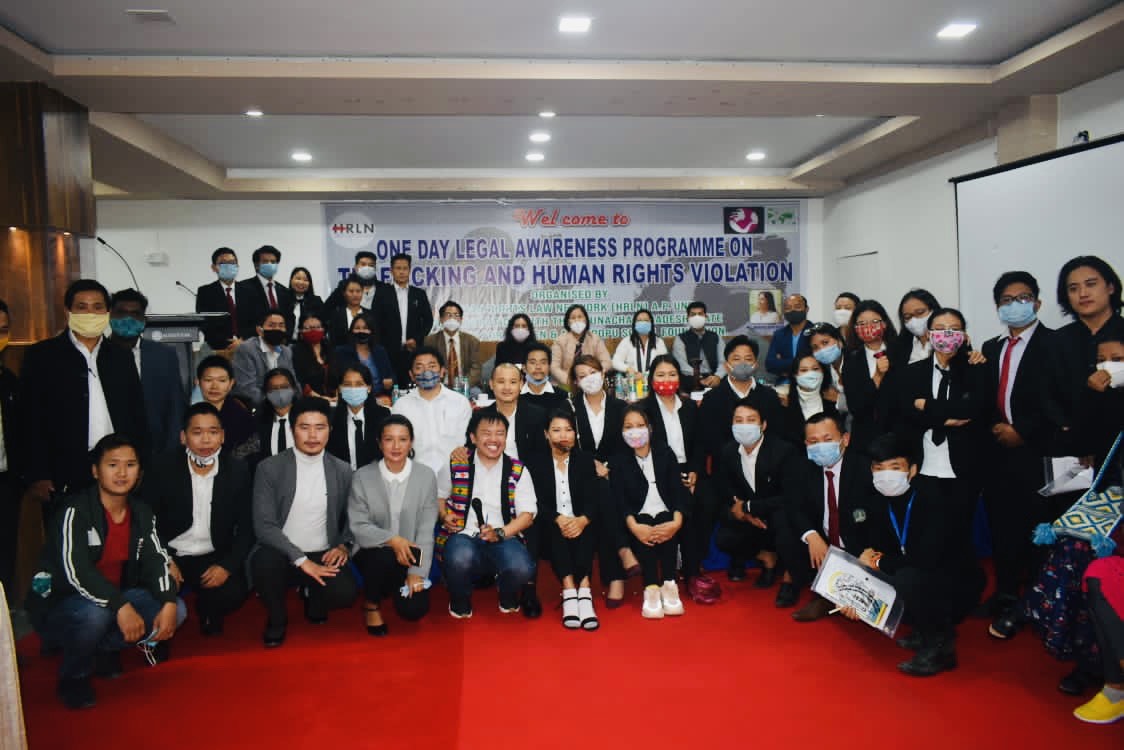
ITANAGAR, Dec 6: "Human rights violations and trafficking cannot be addressed only with laws. Concerted effort is needed to put together by legal professionals and law enforcers backed by active civic organizations to prevent situations and vulnerabilities of which traffickers take advantage," noted Hasina Kharbhih, founder of Impulse NGO Network and one of the leading figures against human trafficking in India and abroad.
Citing figure of trafficking cases in the Northeast and other parts of the country over the last three years, Kharbhih pointed out that lack of economic opportunities and social media had become a new medium for traffickers to track and exploit vulnerable sections of society especially women.
She was addressing a one day awareness program on trafficking and Human Right Violations organised by Human Rights Law Network (HRLN-AP Unit) in collaboration with Arunachal Pradesh State Commission for Women (APSCW).
She underlined that traffickers through Craigslist or " pop-ups " hosting links accessible in many social media applications and websites use to lure vulnerable women.
Mentioning this, she referred to one particular case out of many which surfaced during lockdown the NGO came across, wherein a young girl told that she was duped via " messenger " and got trafficked under false pretenses.
Also, she shared the untold hardship her NGO faced after rescuing trafficked girls especially referring to a case from Bhalukpong, West Kameng district in terms of rehabilitating the girl.
Kharbhih told that the rehabilitation of those rescued persons is one of the main problems that her NGO faces most of the time.
"Human trafficking knows no boundaries ; has no tribe, culture and demographic restrictions," she undermined while calling for a concerted effort by the concerned state governments, authorities and common people to overcome the serious issue.
Radhilu Chai Techi, chairperson APSCW and Techi Hunmai, member APSCW spoke about the role and responsibilities of the commission in dealing with such problems.
Kani Nada Maling, general secretary, Arunachal Pradesh Women Welfare Society (APWWS) while sharing her ordeal in fighting against the trafficking issues in the state informed that women and children are the most vulnerable groups of trafficking in the state.
She also informed that mainly forced labour in the form of domestic help wherein children are brought from intra-region is one of the main problems that has been reported most of the time. State nodal officer for anti-trafficking unit and SP Crime, Rohit Rajbeer said that the trafficking issue existing in the state is due to people’s unwillingness to report such events to the police.
The police department has received less than 20 cases registered under the human trafficking issue till date, he disclosed requesting people to be vigilant and report whenever they came across suspicious cases of human trafficking.
Sharing her experiences, Advocate Mepung Tadar Bage, former chairperson APSCW underlined that forced labour, forced marriage and sexual exploitation of girl child in the form of an age-old bonded labour system are prevalent in the state. She called for a strict law to end the menace permanently.
Karpu Chisi, sub-editor, Independent Review in her case study of Arunachal about human trafficking presented two different cases of the state.
She recalled the true-life story of an 8-year old girl allegedly handed over to a 45-year old man as a bride in return of an alleged amount of Rs 5 lakh was her first case study.
The second was of how social networking site WhatsApp is being used as a medium to sell babies online. She appealed to the people to act responsibly in overcoming these illegal practices.
Social activist and advocate, HRLN, Madan Milli and others also delivered speeches.
Kenter Joya Riba
(Managing Editor)She is a graduate in Science with post graduation in Sociology from University of Pune. She has been in the media industry for nearly a decade. Before turning to print business, she has been associated with radio and television.
Email: kenterjoyaz@easternsentinel.in / editoreasternsentinel@gmail.com
Phone: 0360-2212313