
-
36-hr ICR bandh marred by sporadic violence, Sub inspector…
-
Governor condoles demise of Bengia Tolum
-
Arunachal Pradesh to undertake Special Intensive Revision of …
-
Large acreage of wild cannabis destroyed in joint…
-
New community hub 'Ekta Bhawan' opens at Yazali Police…
-
Dr. Joram Aniya calls on Governor
-
Indian Army inaugurates transit facility at Sigar Military Station
-
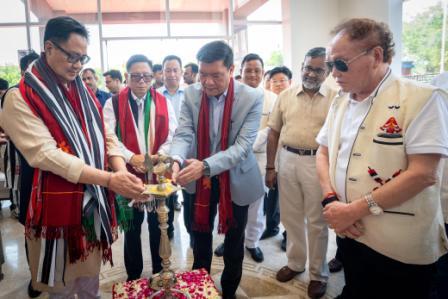 Khandu inaugurates Arunachal Niwas, fourth facility in New Delhi
-
ACS announces sit-in protest, demands CM’s resignation on moral grounds
-
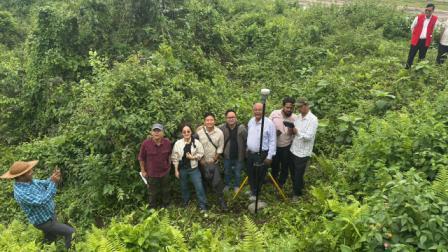 Assam-Arunachal border delineation exercise concludes in Lower Siang
By Tayi Taggu
At the Indira Bhawan, Lal Bahadur Shastri National Academy of Administration (LBSNAA) Mussoorie, people are warned not to open windows and doors in bold letters to avoid monkey menaces. This warning did not come to my head, and I did not see any monkeys during my first three days of stay and willfully kept my room door open despite the warning by the Bhawan authority. Perhaps I was overconfident due to my ignorance and felt it so long as I remained inside; no monkey would ever dare enter my room. That was my perception until the third day, and a monkey proved me wrong on the fourth day, and I had to eat my thoughts.
LBSNAA officials warn all room dwellers, ‘To avoid monkey menaces, please keep the balcony's door and window closed.’ This warning is displayed on every table under a glass of Indira Bhawan Room in bold letters, and their advice should have been taken seriously. Yet I was careless, so I had to face the intrusion of the Rogue Monkey in my room. I realized my mistake, wisdom comes from experience, and carelessness was an act of foolhardiness out of ignorance.
On September 25, 2024, while I was reading ‘Beyond Religion’, a book written by His Holiness (the Dalai Lama) gifted to me by a Buddhist friend on my table near the window. Whileengrossed in the book, I heard the sound of a plastic bag, but it was so sudden that thebull monkey fled away with my Mosambi. Alas! It happened so suddenly in a flash of light; there was no time for reaction. Before I could understand what actually happened, the rogue monkey was sitting on the balcony fence, munching on the Mosambi, as if it truly belonged to him, just two meters away from me.
In the aftermath of the incident, I tried hard to drive him out by whistling, and hissing, but the rogue monkey did not simply care. I was annoyed, angry, and surprised!I wonder what else I could do now, the monkey has outclassed me, and my headrun out of wits. How did the monkey know the fruitswere kept on the safest corner of the table? I guessed he diligently surveyed from the window without making any noise and took away the fruits from the table where I was reading in a split second. “Can a monkey be quite tricky in stealing like a man?” I said to myself. I was upset, and then, of course, lost into mythoughts.
Amid the confusion, a wise thoughtcomes to me, “Daane Daane mehlikha hekhane wale ka naam.!” It is an adage-the name of a person who shall eat the grain is written on it. And I’m not sure, but it might be true; the rogue monkey's name was written on the Mosambi. Any normal human being would feel awkward in the given circumstances, and I was no different. I came to compromise, soften my thoughts and get sober.And then my feelings knock me why should I feel sad and angry for two nos of Mosambi? Yes, therewas no reason to feel bitter soI was happy instantly again. Capturing the Rogue Monkey in my mobile camera is a better option; he is a loner and perhaps theking of the Indira Bhawan.
The rogue monkey was sitting and munching on the Mosambi, hardly two meters away from my window, and my hissing and shouting didn’t affect him. It seems he is immune and does not careabout men shouting. From the appearance, he acts as if he is the boss, and of course, undoubtedly, he is the rogue king of Indira Bhawan. I realize that man in the real sense is a helpless creature minus his intelligence, weapon, and equipment on hand. The rogue monkey appears to know all men's weaknesses and is ready for a duel, and if there is a fight, he will win hands down with certainty. He is armed with two big canine teeth capable of tearing into a man's body, and a man without weapons on hand cannot fight back any animal’s arms with big canine teeth and claws. Man knows his limitations and powerlessness in the absence of weapons.
After eating the Mosambi, the monkey walks away as if he is the King and certainly, he appears to be the King of Indira Bhawan.And I wonder how long his regime would last. And it was my first and last encounter with the King.
Mussoorie, the queen of hill stations, is famous for its scenic beauty, and the Lal Bahadur Shastri National Academy of Administration (LBSNAA), where all Indian Civil Service officers are given training to make them the most responsive administrators so that they canprovide the best services to different regions and states of India. The Mussoorie is dotted with mesmerizing waterfalls and towering mountain peaks. And when one is in the mountains, one can always feel the presence of God. The beautiful cliffs, panoramic views, variety of flora and fauna, and snow-covered mountains in winter make Mussoorie a special tourist place in India.
LBSNAA was established in 1959 in Mussoorie and has gained global recognition as a world-class institution for training Civil Servants in India and many other Southeast Asian countries. It also provides induction civil training to members of All India Services and Central Services (Group A) through a common foundation course. It is a well-known fact that Mussoorie and LBSNAA are a dream destination for all aspirants preparing themselves as future civil servants of India. It is a premier training institution for all civil servants of India. Incidentally, the Mussoorie is said to have been officially discovered by Captain Fredrick Young in 1827, however, thousands of years before him, nameless sages and hunters frequented the place, and their names were never recorded. The Garhwali is the main language spoken by people.
It is worthwhile to say that while enjoying the salubrious climate of Mussoorie, one feels like living in God’s land, and it’s so tempting, promising, and mesmerizing that God must have given his hand to create such an enduring scenic beauty.
Pasighat temperature was extremely boiling and virtually everyone felt they were cooking under a big oven before I left the Pasighat for Mussoorie for one-week training at LBSNAA. While I was in the Mussoorie, one person WhatsApped to me: Pasighat temperature on that day was 38°C but felt like 48°C, and Ruksin temperature was 41°C and felt like 51°C. Thatwas disturbing and troubling news, and the whole of Arunachal Pradesh was boiling under fire in September this year. This is unprecedented and never experienced by the older generation, and nowclimate change is hitting us veryhard. In contrast to Pasighat, the daytime temperature of Mussoorie ranges from 19°C to 22°C, and the nighttime temperatures of 15°C to 16°C are so comfortable and very pleasant, capturing my heart and mind. The excitement and ecstasy overwhelmed me, and there was a feeling of joy in escaping from the ordeal of undergoing the oven-boiling temperature of the Pasighat in Arunachal Pradesh.
The mankind must realize sooner the better, the earth is sending out distress signals and ultimately, it appears that climate change is catching us in different ways, affecting our health and agricultural production negatively, and lessening the working hours of our people. Peoplesought answers and wants to fix responsibilities to take actionto reduce climate change. Can we make them regret for their action and ask them to pay? Answers are likely to take time, therefore instead of waiting for the answer, and blaming who did what, if all of us can plant a plant that is the best thing to happen for our future generation.The reason is obvious we don’t need any help fromthe government to plant a plant; we only need our will to do and that’s so powerful action, that can save the Mother Earth.
Our training was conducted on Municipal Finance on Urban Local Bodies for Urban Administrators by experts from the World Bank. The World Bank feels it's the right time for India to re-look and inject a new lease of life into old urban crumbling infrastructures of towns and cities to make them liveable and vibrant to generate more revenue. Urban areas occupy only 3% of the total land surface area of India,but the urban areas contribute 60% of the country's revenues. To rejuvenate our urban towns and cities, Hon’ble Prime Minister Narendra Modi launched the Atal Mission for Rejuvenation and Urban Transformation (AMRUT) to create sustainable infrastructure, water supply and robust sewage networks, and the Smart Cities Mission (SCM) aims to develop 100 cities as smart, sustainable, and citizen-friendly urban spaces to improve the quality of life by providing efficient services.
Our young civil servants in Arunachal Pradesh are regularly trained at LBSNAA to make thembetter and responsive administrators for future challenges of our state. This is a good opportunity for all of us to hone our skills, and the kind of exposure we get today is far beyond the imagination of our seniors who went on superannuation some years ago. The credit goes to our young and proactive Hon’ble Chief Minister Shri Pema Khandu, under whose leadership and initiative our Civil Services officers of the state get a chance to be trained at all Indian levels to have a broader perspective and understanding of our country. In addition, we civil servants of the state are tremendously grateful to him for upgrading our skills and making us better equipped to face tomorrow's challenges.
The journey that got started through an encounter with a rogue monkey, ended on a fruitful note when I met Amit Yadav Sir (1991 IAS), now Secretary of the Social Justice and Empowerment, Government of India, who came here at LBSNAA to give a talk on ‘Challenges for Financing Urban Infrastructure and Services in India.’ He was my Deputy Commissioner at ‘C’ Sector Itanagar three decades ago; he was a very handsome young man then, and now age is catching all of us in more than one way, and this is the truth of life.
The lessons learnt at Indira Bhawan, LBSNAA, Mussoorie will forever remain engrained in my heart.
The writer is Deputy Commissioner of East Siang District of Arunachal Pradesh.
Kenter Joya Riba
(Managing Editor)She is a graduate in Science with post graduation in Sociology from University of Pune. She has been in the media industry for nearly a decade. Before turning to print business, she has been associated with radio and television.
Email: kenterjoyaz@easternsentinel.in / editoreasternsentinel@gmail.com
Phone: 0360-2212313