
-
Governor participates in Seva Sankalp Utsav
-
CM calls for roadmap to strengthen livelihoods of Yak rearing…
-
Mein calls for preservation of indigenous games, youth empowerment
-
Rozgar Guarantee Yojana for RSS-BJP workers: Congress cries foul on…
-
East Siang Police organises workshop on crime scene management…
-
3rd Greater Siang Badminton Tournament kicks off with 339 players
-
Governor chairs meeting to strengthen telecom network in Arunachal
-
Tagak stresses on youth empowerment at ‘Chai Pe Samwad’
-
DLMC meeting held at Aalo
-
State Wushu association conducts selection trials for national…
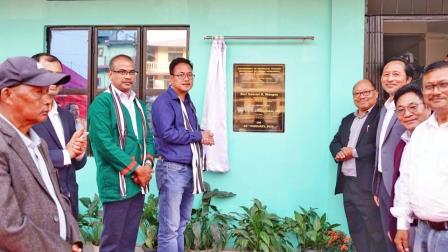
Nirjuli, Feb 25: State Minister for Animal Husbandry, Veterinary & Dairy Development, Gabriel D. Wangsu today inaugurated the Central Vaccine Depot-cum-Disease Investigation Laboratory (DIL) at Nirjuli in presence of Y. V. V. J. Rajashekar, Secretary AHVⅅ Marina Siram, Under Secretary AHVⅅ Danjan Longri, Director AHV&DD, DVOs and other senior officers from various districts.
Addressing the media after the inauguration, Minister Wangsu described the facility as “a great asset for our state, dedicated to the farmers.” He stated that the infrastructure is now fully ready and equipped with sophisticated machinery to ensure timely detection and management of animal diseases. “This laboratory will serve as a protective mechanism for the livestock of our farmers. With early diagnosis, animal diseases can be effectively taken care of,” he said.
The Minister expressed confidence that issues related to animal health would now be resolved through prompt detection and scientific intervention. He reiterated that the State Government remains deeply concerned about farmers’ welfare and is working with sincerity toward cattle upgradation and enhanced production to meet market-driven demands. He acknowledged the continued support of the Government of India in strengthening the livestock sector.
Raising concern over the declining livestock population in the state, particularly mithun, the Minister noted the large-scale slaughter of mithun during festivals and events. Calling mithun the “gentle giant” and the pride of Arunachal Pradesh, he cautioned, “If we do not take care of mithun, we may lose our prized posession as the number one mithun-rearing state in India.”
Worth mentioning that the core mandate of this Laboratory includes early detection and diagnosis of livestock and poultry diseases, surveillance and monitoring of economically important and zoonotic diseases, support to national disease control programmes, outbreak investigation, and strengthening disease reporting systems. The facility will act as a critical link between field veterinarians and policy-level decision-making.
Given Arunachal Pradesh’s diverse agro-climatic conditions and challenging terrain, there is the need for a strong diagnostic backbone. Timely and accurate diagnosis will help reduce livestock mortality, improve productivity, enhance farmers’ income, and safeguard public health. The laboratory will also reduce dependence on out-of-state testing and ensure faster response during outbreaks.
The laboratory will undertake routine testing for diseases such as Foot and Mouth Disease (FMD), PPR, Brucellosis, Classical Swine Fever, and various parasitic and bacterial infections. It will conduct post-mortem examinations, support disease surveillance, assist in outbreak response, provide technical guidance to field officers, and organise training and awareness programmes. Infrastructure strengthening, including procurement of laboratory equipment, cold chain maintenance, and supply of consumables, will ensure uninterrupted functioning.
The laboratory has been strengthened under the Livestock Health and Disease Control Programme (LHDCP) of the Government of India. Funding was provided under the National Animal Disease Control Programme (NADCP) in two phases — ₹30 lakh in 2024–25 and ₹13 lakh in 2025–26 — totalling ₹43 lakh. The construction work was executed by the Water Resources Department (WRD).
Looking ahead, the department has proposed upgrading the laboratory to BSL-2 standards, strengthening molecular diagnostic capabilities, integrating digital disease reporting platforms, and enhancing coordination with district laboratories to improve biosecurity and preparedness against emerging diseases.

Kenter Joya Riba
(Managing Editor)She is a graduate in Science with post graduation in Sociology from University of Pune. She has been in the media industry for nearly a decade. Before turning to print business, she has been associated with radio and television.
Email: kenterjoyaz@easternsentinel.in / editoreasternsentinel@gmail.com
Phone: 0360-2212313