
-
Governor participates in Seva Sankalp Utsav
-
CM calls for roadmap to strengthen livelihoods of Yak rearing…
-
Mein calls for preservation of indigenous games, youth empowerment
-
Rozgar Guarantee Yojana for RSS-BJP workers: Congress cries foul on…
-
East Siang Police organises workshop on crime scene management…
-
3rd Greater Siang Badminton Tournament kicks off with 339 players
-
Governor chairs meeting to strengthen telecom network in Arunachal
-
Tagak stresses on youth empowerment at ‘Chai Pe Samwad’
-
DLMC meeting held at Aalo
-
State Wushu association conducts selection trials for national…
Aalo, Apr 5: With almost all districts in Arunachal Pradesh announcing a ban on import of vegetables from Assam which has seen a recent upswing of Covid-19 cases, people’s reaction to this perceived shortage has remained widely different in the state’s urban and rural areas.
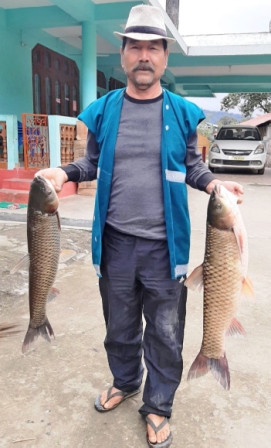
While the concern, restlessness and mad rush for procuring essential commodities including vegetables among the urban population is quite visible, in the state’s countryside, the rural counterparts seems not that much worried. The reasons for this confidence lie in their reliance on locally produced agri-horti-fishery products and their effective marketing which has thereby ensured a zero scarcity situation. The notable exponents of this encouraging trend of self-reliance are the rural farmers and one such is Raken Padu, a retired Commandant of Police who prefers to stay in countryside cultivating fish, vegetables, paddy and taking to piggery, bee-keeping etc. He sells a variety of fish ranging from small ones to more than 5 kgs in weight with facility even for online orders and home deliveries. Similar is the story of Togi Tali, who after retiring from government service has devoted himself to cultivation of food grains and the villagers count on him at times of scarcity of food grains.
The fact that survival instinct is always high among the rural people has once more being corroborated and it’s out of sheer hard work and indigenous capabilities, stocks of food grains, bamboo shoots, dried meats and fishes, vegetables remain abundant despite absence of modern facilities. Many other progressive farmers are now ensuring that there remains a steady supply of safer and organic green vegetables and food grains all throughout the lockdown. The state’s Department of Agriculture has invited all such progressive farmers for supply of essential commodities at regulated prices in the township areas. The crisis, thus, has reminded the state an important aspect which is to strive for attaining self-reliance in food.
Meanwhile, rural Arunachal has taken the lockdown seriously and to reinforce it further, local customs particularly those seen in West Siang district like the Ali-Ternam and Yulu Monam which barricade the roads leading to villages are now being put into application. Reportedly, in many places the barricading has been extended up to April 21 after the state recorded its first Covid-19 positive case a few days back. DIPRO

Kenter Joya Riba
(Managing Editor)She is a graduate in Science with post graduation in Sociology from University of Pune. She has been in the media industry for nearly a decade. Before turning to print business, she has been associated with radio and television.
Email: kenterjoyaz@easternsentinel.in / editoreasternsentinel@gmail.com
Phone: 0360-2212313